MINDSET OVER METHOD → THE COURSE
Every organisation runs on an operating system. Yours has never been examined.
Mindset Over Method is a 17-lesson masterclass that makes the invisible system driving your operation visible — the default patterns of thinking, deciding, and responding that determine what actually happens when a plan meets reality.
The pattern underneath every recurring problem.
You've restructured. Retrained. Rolled out new frameworks. Some of them were good. Some of them should have worked. And the same problems keep showing up — different names, same shape.
This is not a failure of effort or intelligence. It is a structural issue.
Every organisation runs on a set of default patterns — how it thinks about problems, how it makes decisions under pressure, how it responds when something goes wrong. These patterns aren't written down. They're not in any manual or org chart. They are the invisible operating system running underneath every method, tool, and restructure you deploy.
Methods are software. They only work as well as the operating system allows.
When you install new software on a broken operating system, you get the same failures in a different format. Restructures produce the same dysfunction in a new shape. Training fades because it changed what people do without touching how they think. Your best people leave while your most mediocre processes survive — because the OS rewards compliance over contribution.
This pattern has a price. I've watched it paid.
In 2015, the fintech I worked for hired experienced consultants to attack the lead time on our flagship analysis process. We mapped every step. We cut a 44-week process to five. The work was excellent. The Group CEO was watching.
Then the consultants left. Within three months, the impetus was gone. The timeline held — but nobody was hunting the next inefficiency. Nobody had adopted the thinking that made the win possible.
We'd bought the method. We hadn't built the mindset.
That moment is why this course exists — and why it starts with thinking, not tools. When the thinking stays with the consultant, the improvement leaves when they do.
The problems you're solving this quarter look suspiciously like the ones you solved two years ago. The tools aren't failing. The operating system underneath them is.
Not another toolkit. A different operating system.
This course does not start with tools. It starts with the operating system that determines whether any tool works.
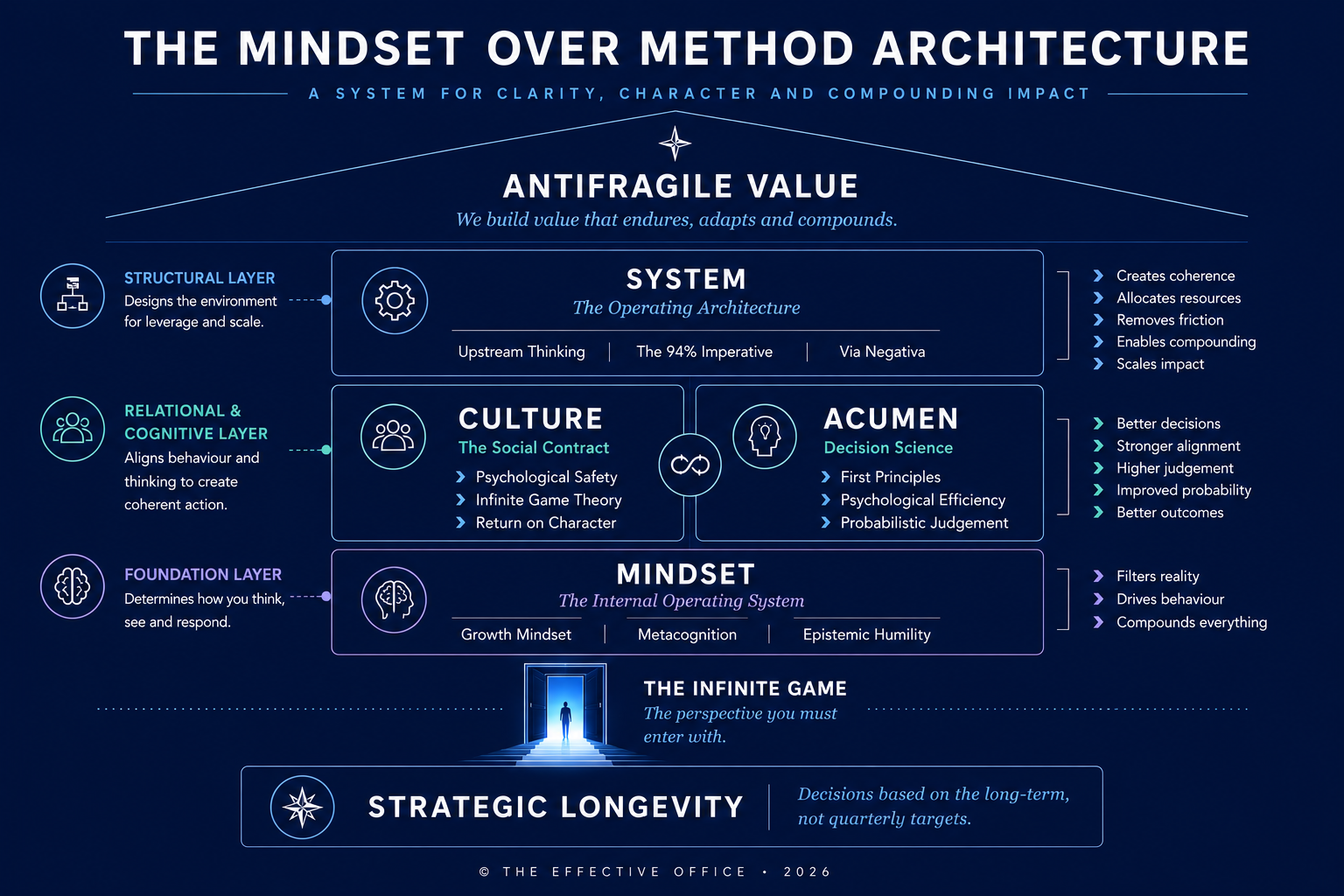
It works through four layers — each building on the last. First, it surfaces the cognitive patterns you can't see from inside them. Then it builds the diagnostic discipline to stay in a problem long enough to find the right question. Then it shows you how to design the environment — the signals, the rewards, the norms — that determines what your team actually does under pressure. Finally, it gives you the structural logic to make the organisation do what you need it to do by default, not by force.
Mindset. Acumen. Culture. System. Four cornerstones. Seventeen lessons. One integrated framework — built from behavioural psychology, decision science, Lean methodology, and systems thinking.
WHAT MOST COURSES TARGET
The methods, tools, and frameworks your team uses
WHAT THIS COURSE TARGETS
The operating system that determines whether those methods work
This course is not for everyone. Read this before you go further.
Mindset Over Method is built for leaders who are willing to question the thinking behind their decisions — not just the decisions themselves. It requires intellectual honesty, a tolerance for discomfort, and the willingness to sit with a problem longer than feels natural.
This course is not for you if:
- You want a quick-fix toolkit you can deploy without changing how you think
- You believe leadership development is something you send your team to, not something you do yourself
- You're looking for someone to validate your current approach rather than challenge it
- You want theory without application, or application without understanding why it works
- You expect a course to solve your problems for you — this one gives you the thinking to solve them yourself
- You need a certificate, badge, or credential to justify the learning to yourself or your employer
This course is for you if:
- You've tried training before and watched it fade — and you want to understand why
- You suspect the problem in your organisation is upstream of the tools you've been given
- You're willing to examine your own thinking before asking your team to change theirs
- You want a framework that connects research to practice in a way no single book provides
- You're ready to invest just under five hours in changing how you think — not just what you do
- You want behavioural change your team can see — not a line on LinkedIn
A note on what you won't get.
You may be wondering what you walk away with — whether there's a certificate, a badge, something to point to.
There isn't. That's deliberate.
Certificates prove attendance. They don't prove the thinking changed. A leader who needs a certificate to justify the learning is signalling that the learning itself isn't enough — and this course is built on the opposite premise.
The proof is behavioural. Your team will notice different questions in meetings. Decisions will sharpen. The frameworks you apply — Pre-Mortem, 5 Whys, the Three Strategic Questions — will be visible in how you lead. A credential your peers can see working, not one they have to take on trust.
If a badge is what you need, a university programme is the better fit. If a change in how you think is what you need, this is.
A moment from the course.
4 modules. 17 lessons. One framework that changes how you think.
The 4 Cornerstones framework integrates research from behavioural psychology, decision science, Lean methodology, and systems thinking into a single coherent structure. No single book provides this synthesis. No conference talk covers this range. Each module builds on the last. The sequence matters.
MODULE 1
Mindset
Challenge the assumptions you don't know you're making
4 lessons · 54 min
MODULE 2
Acumen
Build the diagnostic skills most leaders skip
5 lessons · 84 min
MODULE 3
Culture
Design the environment, not just the rules
4 lessons · 68 min
MODULE 4
System
Make the organisation do what you need it to do
4 lessons · 76 min
MODULE 1 — MINDSET
Challenge the assumptions you don't know you're making
4 LESSONS · 54 MIN
This module exposes the cognitive patterns — confirmation bias, competence traps, institutional dogma — that cause intelligent leaders to make predictable errors. The goal is not self-awareness as an abstract aspiration; it is the operational capacity to notice when your thinking is being distorted, in real time, under pressure.
LESSON 1
The Invisible Operating System
Every method is only as effective as the mindset driving it. Upgrading processes without examining assumptions is running new software on a broken operating system.
FRAMEWORK / TOOL
Psychological safety assessment (Project Aristotle framework); the "operating system" diagnostic
WHAT YOU'LL DO DIFFERENTLY
Audit whether your team's performance reflects your processes — or the unexamined beliefs driving how those processes are used
LESSON 2
The Curse of Competence
Expertise rewires the brain in ways that actively resist new information. The skills that built your career are now the primary constraint on your future impact.
FRAMEWORK / TOOL
Pre-mortem technique; Error-Related Negativity reframing; Antifragility applied to leadership
WHAT YOU'LL DO DIFFERENTLY
Run a pre-mortem before your next major initiative — and notice what your team reveals that they would not have volunteered otherwise
LESSON 3
Blind to Blindness
Cognitive biases are not individual failings — they are organisational vulnerabilities. You cannot think your way out of a bias you are inside.
FRAMEWORK / TOOL
Red team assignment; probabilistic scoring; structured decision environments
WHAT YOU'LL DO DIFFERENTLY
Assign a formal red team role in your next strategy session — rotating, standing, with explicit permission to challenge
LESSON 4
Slaying the Sacred Cow
Dogma persists not because people lack intelligence, but because challenging it carries a personal cost. What looks like apathy is often learned futility.
FRAMEWORK / TOOL
Double-loop learning (Argyris); the "first principles" audit question; sanctioned challenge mechanisms
WHAT YOU'LL DO DIFFERENTLY
Pick one recurring process your team follows without question and ask the person closest to it: "If we were designing this today, would we design it this way?"
MODULE 2 — ACUMEN
Build the diagnostic skills most leaders skip
5 LESSONS · 84 MIN
This module builds the diagnostic discipline to stay in the problem space long enough to find the right question, resist the pull of premature solutions, and structure your thinking so the output can be trusted.
LESSON 5
The Solution Trap
Resources are allocated to solutions before the problem is understood. The culture of visible action is the primary enabler of this pattern.
FRAMEWORK / TOOL
Process Improvement Framework (4-step diagnostic); the LA reservoir reframing case
WHAT YOU'LL DO DIFFERENTLY
Spend the first ten minutes of your next solution-focused meeting on a single question only: "What is the problem we are actually trying to solve?"
LESSON 6
Silence as Strategy
The expert's instinct to provide answers is a ceiling on organisational capacity. Shifting from answer-provider to question-asker is a governance decision, not a communication style preference.
FRAMEWORK / TOOL
W.A.I.T. protocol (Why Am I Talking?); Edmondson's genuine curiosity test; the silence-as-leadership-act reframe
WHAT YOU'LL DO DIFFERENTLY
In one meeting this week, redirect the group's request for your position with a question instead. Notice what surfaces that would not have surfaced otherwise
LESSON 7
Moneyball for Management
Most organisations do not solve problems — they inherit solutions. Reasoning by analogy is how constraints get mistaken for facts.
FRAMEWORK / TOOL
First principles decomposition; scientific thinking applied to management (observation → hypothesis → test → analyse); cognitive entrenchment diagnosis
WHAT YOU'LL DO DIFFERENTLY
Identify one constraint your organisation treats as fixed and test whether it actually is — rather than accepting it as a given
LESSON 8
The Architecture of Judgement
Most leaders examine what they think — almost none examine how they think. High-quality judgement requires four distinct cognitive modes used in sequence.
FRAMEWORK / TOOL
Four thinking modes (generative, analytical, evaluative, reflective); MECE standard as quality check; 30-day decision journal
WHAT YOU'LL DO DIFFERENTLY
After your next significant decision, record your rationale, confidence level, and expected outcome before the result is known. Review it honestly at 30 days
LESSON 9
Logic is a Lie
Perceived reality governs behaviour more reliably than objective reality. What customers and employees say they want is a poor guide to what will actually change their behaviour.
FRAMEWORK / TOOL
Stated vs revealed preference gap; the Eurostar reframing; Peak-End Rule applied to organisational processes
WHAT YOU'LL DO DIFFERENTLY
Identify one process in your organisation where the work is a "black box" to the people waiting on it. Design one visible signal that makes progress legible by default
From the course: why the solution that looks obvious is usually wrong.
MODULE 3 — CULTURE
Design the environment, not just the rules
4 LESSONS · 68 MIN
This module reframes culture as a design discipline: the deliberate shaping of the environment through costly signals, reward systems, and the leader's own behaviour under pressure.
LESSON 10
Designing the Tribe
Context shapes behaviour more reliably than character — and leaders design the context. Psychological safety is an economic variable, not an HR one.
FRAMEWORK / TOOL
Fundamental Attribution Error applied to management; Toyota Andon cord analysis (tool vs response); the "anthropologist in the meeting" observation technique
WHAT YOU'LL DO DIFFERENTLY
Go into your next meeting and note who speaks, who stays silent, and what happens to the first person who raises a concern. That observation will tell you more about your culture than any engagement survey
LESSON 11
Return on Character
An organisation is a projection of its senior leadership's psychology — whether or not leadership intends it. Character transmits through costly signals and reward systems, not rhetoric.
FRAMEWORK / TOOL
Upper Echelons Theory; KRW character-ROA data (9.35% vs 1.93%); the four transmission mechanisms (symbolic action, attention allocation, crisis response, reward systems); Johari Window blind spot audit
WHAT YOU'LL DO DIFFERENTLY
Audit your calendar from the past four weeks. Whatever appears first in your meetings is what your organisation believes you actually care about
LESSON 12
Stop Rowing, Start Steering
Efficiency and effectiveness are not the same thing — and optimising the wrong one is the most common form of organisational waste. Busyness is a neurological default, not a cultural failure.
FRAMEWORK / TOOL
Goodhart's Law applied to organisational metrics; the rowing eight analogy (Ackoff); Ringelmann Effect; Timothy Clark's four stages of psychological safety
WHAT YOU'LL DO DIFFERENTLY
Identify one recurring meeting, report, or approval process that consumes collective time without a clear link to a specific outcome. Remove it entirely and observe what is lost
LESSON 13
Winning the Wrong Game
In repeated interactions, cooperation is the mathematically dominant strategy. Short-term extraction creates long-term trust deficits that compound.
FRAMEWORK / TOOL
Axelrod's tournament (Tit for Tat); shadow of the future analysis; costly signal theory; Nash Equilibrium trap applied to internal incentives
WHAT YOU'LL DO DIFFERENTLY
Identify one place where your organisation currently imposes friction on customers or employees that functions as a barrier rather than a boundary. Ask what signal that friction sends
From the course: when doing exactly what you're told becomes the problem.
MODULE 4 — SYSTEM
Make the organisation do what you need it to do
4 LESSONS · 76 MIN
94% of performance variation stems from the system, not the individual. This module shifts leadership attention from managing people to designing the conditions in which high performance is the default — and waste is structurally impossible.
LESSON 14
The 94% Imperative
The Fundamental Attribution Error is not just a cognitive bias — it is a governance risk. Blame produces a neat narrative and no improvement to the system.
FRAMEWORK / TOOL
Deming's 94/6 principle; Poka-Yoke (mistake-proofing as design philosophy); the Narrative Flip ("who?" → "how?"); Mizuho Securities and Goldman Sachs STP case studies
WHAT YOU'LL DO DIFFERENTLY
The next time a failure reaches your desk, replace "who was responsible?" with "how did our system allow this to happen?" — and hold that question in the room long enough to get a real answer
LESSON 15
Death of the Hero
Fire-fighting is not a sign of leadership capability — it is a sign of design failure. The goal of a capable leader is to make themselves redundant to the system's improvement.
FRAMEWORK / TOOL
1-10-100 principle (prevention vs correction vs failure cost); upstream vs downstream leadership; the "lawnmower leader" diagnostic; the six-month absence test
WHAT YOU'LL DO DIFFERENTLY
Look at your to-do list and identify one item that is purely reactive. Trace it one level upstream. Ask: what design decision is producing this problem repeatedly?
LESSON 16
The Replacement Fallacy
AI is the most powerful method available to organisations today — and like every method, it is only as effective as the operating system it runs on. Two-thirds of organisations that made AI redundancies are already rehiring.
FRAMEWORK / TOOL
The Two Spirals (creation intent vs extraction intent); the 83-point gap (BCG upskilling intention-action data); AI redundancy washing (Deutsche Bank); the Gallup trust correlation
WHAT YOU'LL DO DIFFERENTLY
Before your next AI deployment decision, ask: are we designing this to create capacity or eliminate it? Trace the answer through the four cornerstones — mindset, acumen, culture, system — and identify which is missing
LESSON 17
Growth Through Subtraction
Lean fails in most organisations not because the tools are wrong, but because the tools are installed inside an unchanged mindset. 90% of most timelines between order and delivery is waste.
FRAMEWORK / TOOL
The Wasteful Eight; Kaizen vs First Principles (when to optimise vs when to delete); the Giga Press case; Taiichi Ohno's timeline principle
WHAT YOU'LL DO DIFFERENTLY
Walk into your next working day and ask, of the first three processes you interact with: would the customer pay for this step if they could see it?
From the course: what happens when you stop asking "who?" and start asking "how?"
Lesson 14 — The 94% Imperative — "The Mizuho Disaster" (~56 sec)
Short, focused videos — most around 15 minutes. ~4 hours 45 minutes total. Self-paced. Lifetime access.
What you get.
17 video lessons across 4 structured modules
The complete 4 Cornerstones framework — Mindset, Acumen, Culture, System — delivered in ~15-minute videos designed for leaders with limited time and high standards. Self-paced. Lifetime access including future updates.
Lesson one-pager downloads
A single-page distillation of every lesson: the three key insights, why it matters at work, one question to sit with, and one thing to do differently this week. Print them. Pin them to your wall. Use them as team discussion starters.
Full citations and curated further reading
Every claim in the course is sourced. Every lesson includes a reference list with direct links to the original research — books, papers, reports. This is not a course that asks you to take the instructor's word for it.
Process Improvement Framework (downloadable)
A structured diagnostic tool for identifying and resolving operational inefficiencies — drawn directly from Lesson 5. Four steps, each building on the last. Apply it to a current problem in your team this week.
5 Whys Explainer Pack (downloadable)
A practical guide to root cause analysis — including worked examples from manufacturing, professional services, and everyday management. Use it the day you download it.
DIFFERENTIATOR
AI course assistant
Built on ElevenLabs and trained on the full curriculum. Ask it anything about the course content — how a concept applies to your specific context, what lesson covers a particular topic, how two ideas connect. Searchable, conversational, available on demand. This is not a chatbot — it is a curriculum-trained adviser.
14-day money-back guarantee (full course purchase only)
If the course does not meet your expectations within 14 days, request a full refund. No usage limits during the trial period. No justification required. The guarantee exists because the course is good enough to survive the test.
Lifetime access including future updates
When new content is added, you get it. The course grows — and your access grows with it.
Organisational Operating Profile
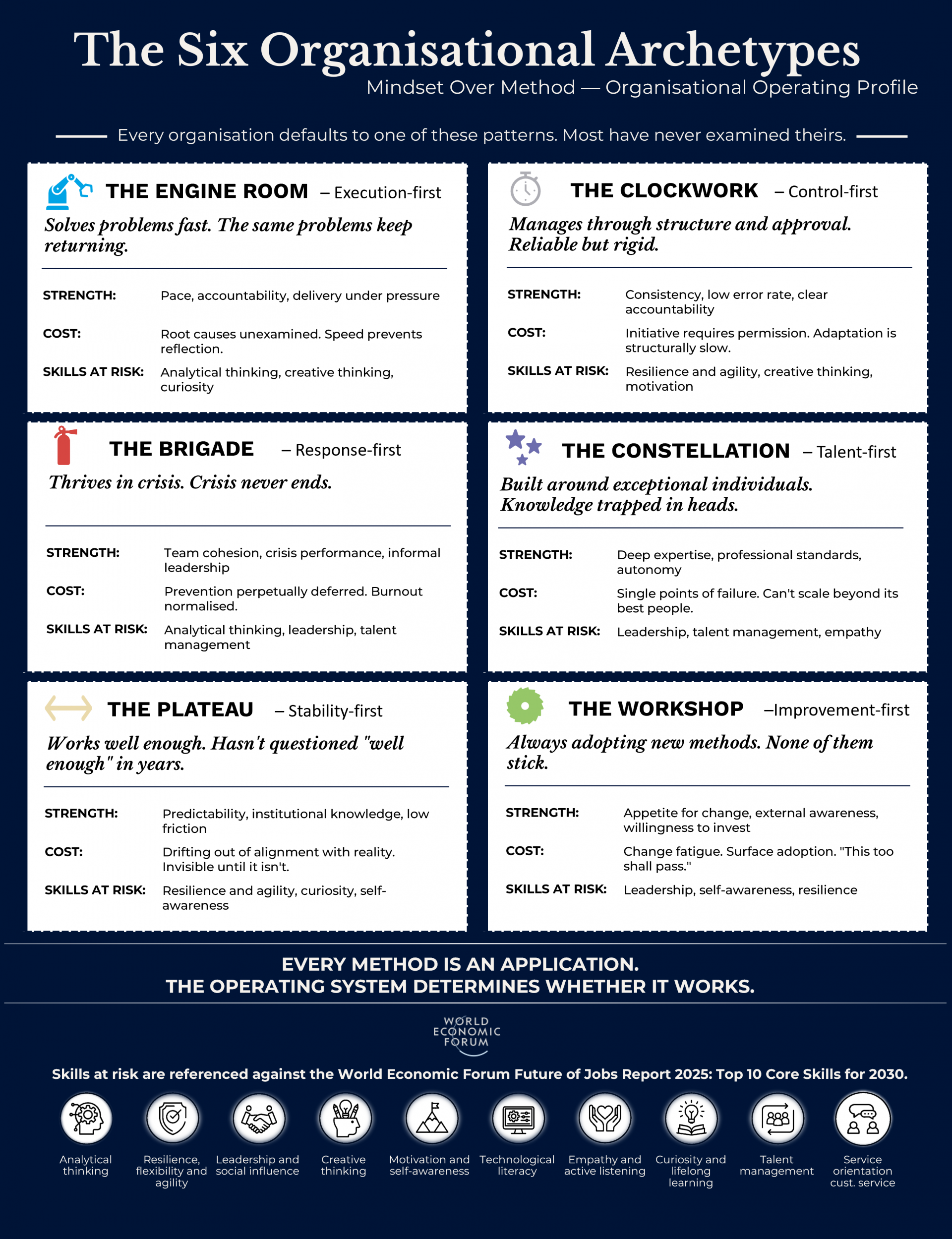
A 17-question diagnostic that identifies your organisation's dominant operating pattern — how it thinks, decides, collaborates, and structures work — and maps the specific WEF 2030 skills at risk. Includes a personalised reframe and targeted course recommendations.
You could read twelve books. Or you could understand how they connect.
This course draws on the work of Kahneman, Dweck, Deming, Edmondson, Ariely, Sutherland, Ackoff, Taleb, Ohno, and others. You may have read some of them. You may have read all of them.
What no single book provides is the synthesis: how confirmation bias (Lesson 3) creates the conditions for cultural normalisation of deviance (Lesson 10), which produces the system failures that leaders then misattribute to individuals (Lesson 14) — and how a single framework can address all three simultaneously.
The value of this course is not in the research it cites. It is in the sequencing, the integration, and the leadership-specific application of that research into a coherent framework you can use on Monday morning.
And on the institution behind this.
You may also be comparing this to a programme from Harvard, INSEAD, or AGSM. That is a reasonable comparison and it deserves a direct answer.
A single INSEAD executive module is typically $10,000+ and four to five days out of your diary. This is AUD $1,799 and just under five hours. If the branded programme produces six times the value, take it. If it doesn't, the brand premium is what you are paying for — and that's worth knowing as you decide.
On the thinking itself: Taleb was a trader. Deming was a statistician working in Japan because America wouldn't listen. Ohno built the Toyota Production System on a factory floor. Sutherland is an ad exec. The assumption that the best thinking lives inside the best-branded institutions is an inherited one, and worth examining.
Branded programmes optimise for credentialing and network. This one optimises for thinking change. Those are different products. If you want the badge and the alumni list, buy the badge. If you want the thinking, this is purpose-built for it.
Built for the skills the World Economic Forum says matter most.
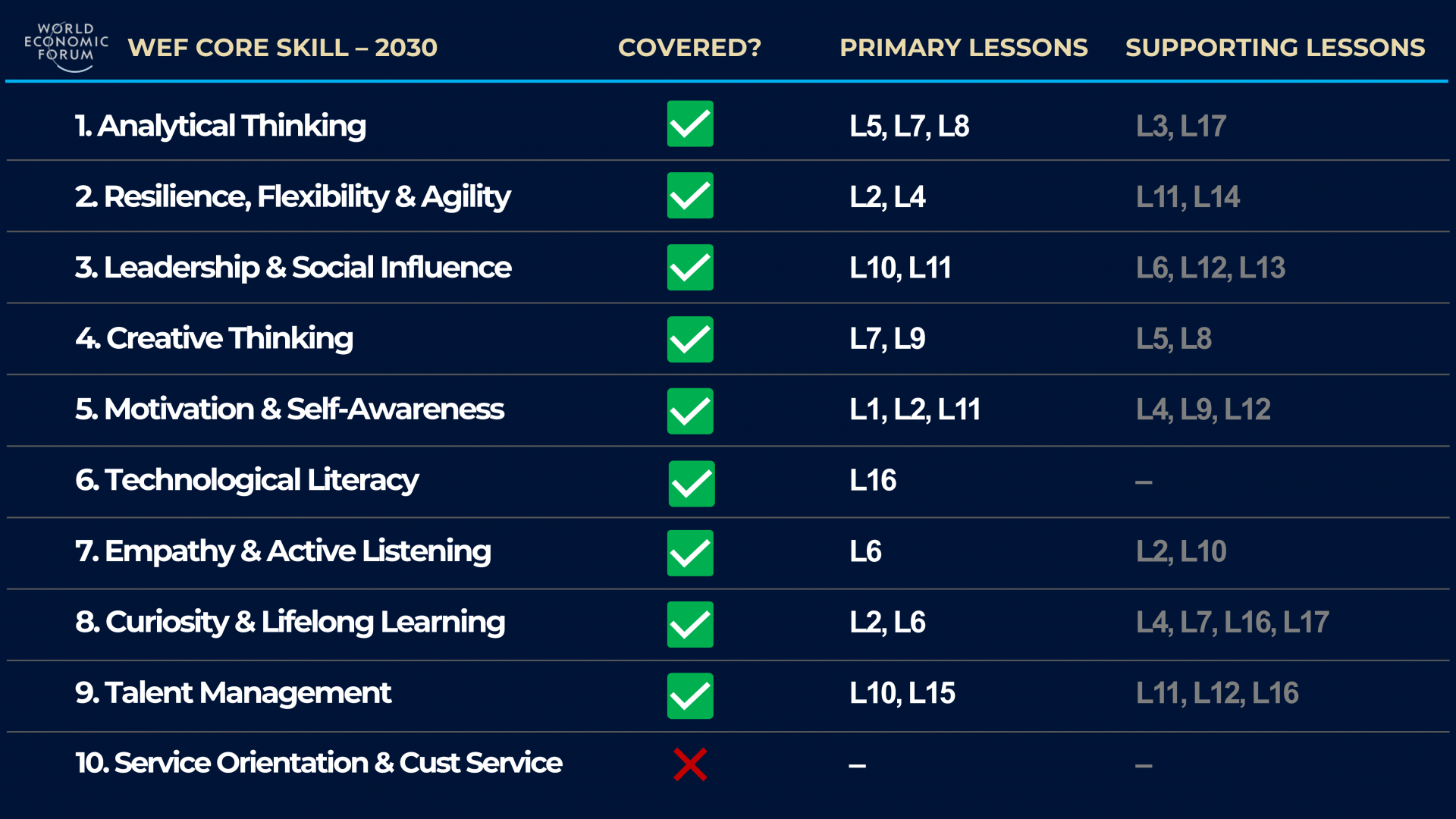
The WEF Future of Jobs Report 2025 surveyed over 1,000 of the world's largest employers, representing 14 million workers. Their finding: 39% of workers' core skills will change by 2030. 85% of those employers plan to upskill their current workforce as their primary response.
The top 10 core skills they identified are overwhelmingly thinking skills — analytical thinking, resilience, leadership, creative thinking, motivation, empathy, curiosity, and talent management among them.
Mindset Over Method directly addresses 9 of the 10. The one it does not cover — Service Orientation — sits outside the course's scope by design. This is a course about how leaders think, not about how frontline service is delivered.
 See the full evidence base →
Your organisation's operating pattern determines which of those skills are at risk.
Every organisation defaults to one of six operating patterns — a dominant mode that was once fit for purpose and hasn't been upgraded. Each has genuine strengths. Each creates blind spots that put a different combination of the WEF's 2030 skills at risk.
The diagnostic identifies which pattern your organisation has defaulted to — and which skills are most exposed. The course addresses the underlying operating system that produces the pattern.
Built on 20+ years of operational transformation.
Danny Turano has spent two decades driving operational transformation, continuous improvement, and cultural change — at Goldman Sachs, ION Group, and TAFE NSW. He's been promoted three times in five years for delivering Lean transformations at scale. He led the operational implementation of an award-winning Indigenous cultural web app. He's helped raise over £3 million for children's charities.
He built this course because he spent 20 years watching the same problems recur — in billion-dollar institutions and in 50-person teams — and he knows what fixes them. Not more tools. Better thinking.
Goldman Sachs·ION Group·TAFE NSW·Good Design Award 2024

Good Design Award 2024
Digital, Web Design & Development
Connect With Country, TAFE NSW
TAFE NSW Gili Awards 2024
Diversity & Inclusion Champion Award
Connect With Country, TAFE NSW
What people who know this work say.
We're early. The course launched recently. Here's what people who know Danny's work — his thinking, his approach, and his results — have to say. As learner outcomes accumulate, this section will grow.
FROM PEOPLE WHO'VE DONE THE COURSE
VERIFIED GOOGLE REVIEW
★★★★★
"After nearly three decades in business, I was sceptical that another leadership programme could offer anything genuinely new. Mindset Over Method changed the way I think, make decisions, and lead people. Its practical frameworks helped me develop a more effective and inclusive leadership style while deepening my understanding of how mindset, culture, and systems drive performance. I would highly recommend it to any leader looking to improve both their leadership capability and organisational impact."
— Desiree Mullan
VERIFIED GOOGLE REVIEW
★★★★★
"Well researched, insightful and impactful when applied. The content is well structured and accessible. Great for people who have to squeeze their learning around a very full schedule."
— Chris T
Unedited Google Business reviews.
FROM PEOPLE WHO'VE WORKED WITH DANNY
"Danny has a deep understanding of the philosophy of Lean Management and its application in the enterprise. He's a passionate advocate of the benefits that Lean Thinking can deliver in terms of clarity of process, the reduction of waste, and increased speed to market."
Anthony Kennedy — Professional colleague, ION Group
"Danny was a long-term trustee and supporter of Futures For Kids. He provided invaluable organisational input for initiatives to find new ways to raise funds for the charity and with events management. As deputy chair of the board of trustees he also provided a practical and sensible voice and efficiency to the operations of the charity. A steady, sensible and reliable contribution."
Emma Davey — Futures For Kids
"I have worked with Danny over many years and he has many significant strengths. As well as being someone who acts with integrity and who can be trusted implicitly, he is incredibly dedicated and hard working. His ability to deliver is as good as anyone I have ever worked with. Attention to detail and a commitment to timelines, means that it always seems that Danny is ahead of the game. On top of the above he is a great bloke. I recommend Danny unreservedly."
Bill Templer — Futures For Kids
LinkedIn recommendations, publicly verifiable.
Who does the thinking?
Every route to organisational improvement answers one question differently: who does the thinking? The market has priced each answer.
Who does the thinking
They think for youLarge-scale consulting transformation
They think with youFocused consulting engagement
They teach, you applyExecutive education
They guide, you developExecutive coaching
You do the thinkingMindset Over Method
In McKinsey's own global survey, only 12% of large-scale transformations sustained their gains beyond three years. Research from Harvard Business School identifies why: people learn new approaches, then return to systems that haven't changed – and the system wins.
The first four rows rent capability. The last one builds it – and it stays with you.
Market ranges are indicative, based on published US-market rates for comparable engagements and programmes. Australian-dollar equivalents are typically higher.
Two ways to start.
SINGLE SECTION
AUD $499
- IncludedOne module of your choice (3–5 lessons)
- AccessLifetime
- DownloadsFor your chosen section
- AI assistantYes
- GuaranteeNot applicable
- Upgrade pathUpgrade to full course at any time for $1,300
FULL COURSE
AUD $1,799
- IncludedAll 4 modules, all 17 lessons
- AccessLifetime
- DownloadsComplete set (all 17 one-pagers, all references, all tools)
- AI assistantYes
- Guarantee14 days, no questions asked
- Upgrade path—
The full course represents a saving of $197 compared to purchasing all four sections individually.
Buying for a team of 10+? Volume pricing and enterprise onboarding available. See team options →
All prices in AUD.
14-day money-back guarantee.
Purchase the full course. If it doesn't meet your expectations within 14 days, request a full refund. No usage limits during the trial period. No justification required.
The guarantee exists because the course is good enough to survive the test. If it's not for you, you'll know within 14 days — and you'll get your money back.
The guarantee applies to full course purchases only. Individual section purchases are not eligible for refund.
How the course works.
01
Purchase and access
Choose the full course or a single section. You'll receive immediate access to the learning portal at dannyturano.com
02
Start where the framework starts
Begin with Lesson 1 (full course) or the first lesson of your chosen section. Each lesson is approximately 15 minutes
03
Learn, apply, reflect
Each lesson includes a one-pager download, a practical action, and a question to sit with. The AI assistant is available to help you apply concepts to your specific context
04
Move at your own pace
One lesson per day gives you a month-long learning path. One lesson per week gives you four months. There is no expiry
05
Upgrade when you're ready
Section buyers can upgrade to the full course at any time for $1,300
Questions you might have.
Can I expense this or get it approved by my organisation?+
Yes. The Effective Office (ABN: 42 794 577 204) provides tax invoices on purchase. For volume purchases (10+), we can accommodate purchase orders and provide a downloadable business case template. See enterprise options →
Is this relevant to my industry / team size / seniority level?+
The principles are universal — they apply across industries, team sizes, and levels. The case studies span Goldman Sachs to Toyota, but the mechanisms they illustrate operate at any scale. The AI assistant can help you map course concepts to your specific context.
I've done leadership development before and it didn't change anything. Why would this be different?+
Most training programmes target behaviour without shifting the thinking that drives it. That's why the effects fade. This course starts with the thinking — the cognitive biases, the unexamined assumptions, the cultural signals — that determine whether any tool or framework actually works. If your previous training gave you methods without this foundation, it was always going to be temporary.
What if I only have time for one section?+
Start with the section most relevant to your current challenge. Each module is self-contained enough to deliver value on its own. If you want to expand later, you can upgrade to the full course for $1,300 — the difference between your section purchase and the full price.
Is there live coaching or community access?+
The course is self-paced by design — it respects your time and autonomy. The AI course assistant provides on-demand support trained on the full curriculum. You are also welcome to contact Danny directly with questions. This is a solo operator, not a faceless platform — which means you get access to the person who built the course, not a layer of junior coaches.
How is this different from reading the books it's based on?+
You could read twelve books. This course integrates their insights into a single framework — with the sequencing, the cross-referencing, and the leadership-specific application that no individual book provides. Just under five hours gives you what months of reading would — and a structure for applying it.
Is there a certificate on completion?+
No, and that's deliberate. Certificates prove attendance, not thinking change. The full treatment is in the exclusion statement above — read that before deciding whether the absence of a credential is a deal-breaker for you. The short version: if a badge is what you need, a university programme is the better fit. If a change in how you think is what you need, this is.
Why this instead of a programme from Harvard, INSEAD, or AGSM?+
Different products. Branded programmes optimise for credentialing and network. This optimises for thinking change. The full comparison — on price, time, content provenance, and what you're actually buying — is in the section above. For the internal-approval case, the business case template on the enterprise page does the translation. See the full evidence base → · See team options →
The thinking changes first. Everything else follows.
Mindset Over Method is a 17-lesson masterclass for leaders who are ready to look at what's really going on inside their operation.
It won't give you another toolkit. It will change how you think about the problems you already have — and why the tools you've tried haven't worked.